Highlights
- Air con cleaning can remove mould, dust and organic build-up from internal components.
- Moisture can create conditions that allow mould to develop inside an air conditioner.
- Musty odours can indicate mould or excess moisture.
- Cleaning can support better indoor air quality.
- Ventilation and moisture control are important alongside regular maintenance.
- Professional cleaning may be appropriate when contamination is extensive or difficult to access.
How Can Air Con Cleaning Remove Mould and Odours?
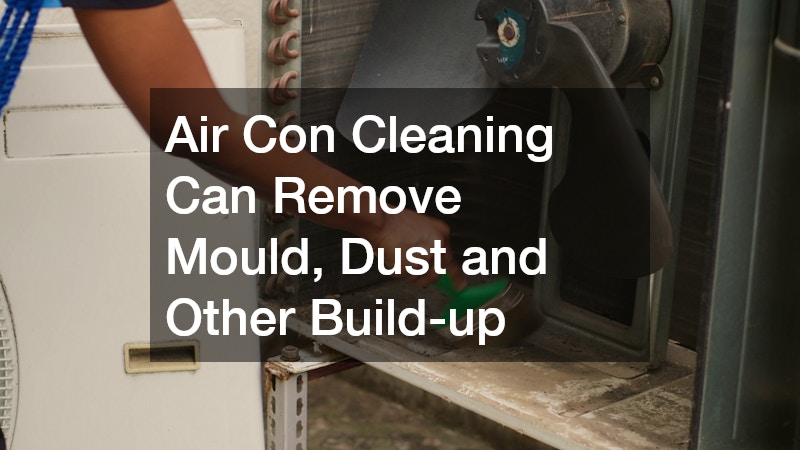
Air con cleaning can remove mould, dust and organic build-up that contribute to unpleasant smells. Air conditioners move air through filters and internal components where particles and moisture can accumulate.
If damp conditions persist, mould may develop on suitable surfaces and produce a musty odour when the system operates.
According to NSW Health, mould may grow indoors in wet or moist areas that lack adequate ventilation, including insulation and other building materials. The health authority also explains that mould spores can cause health problems for people who are sensitive or allergic to them.
Cleaning affected components can remove existing contamination, but the source of moisture also needs to be addressed if mould keeps returning.
Why Does an Air Conditioner Develop Mould?
Mould needs moisture to grow, making air conditioners vulnerable when condensation or dampness remains inside the unit. Filters can collect dust while coils and drainage components may become damp during normal operation. Poor drainage or inadequate maintenance can therefore create conditions that support mould growth.
Humidity inside the home can contribute as well. An air conditioner can remove moisture while cooling, but the system needs to operate correctly and have appropriate drainage. A persistent musty smell may therefore indicate an underlying moisture issue rather than simply a dirty filter.
Cleaning should remove existing build-up while maintenance should investigate drainage, moisture and ventilation problems that could allow mould to return.
Which Parts of an Air Conditioner Need Cleaning?
Different components can collect dust and moisture during normal operation. The exact cleaning requirements depend on the system, but common areas include:
- Filters: Capture airborne particles and require regular cleaning or replacement according to manufacturer instructions.
- Evaporator coils: Can accumulate dust and moisture over time.
- Drainage components: Blockages can allow water to accumulate inside the unit.
- Fans and blowers: Dust can collect on moving components.
- Louvers and vents: Surface build-up can contribute to unpleasant smells.
Routine filter maintenance may be suitable for homeowners when permitted by the manufacturer. Internal components can be harder to access and may require professional cleaning.
Can Air Con Cleaning Help Remove Musty Smells?
Yes. Cleaning can reduce musty smells when they are caused by mould, dust or organic material inside an air conditioner. A smell that becomes noticeable whenever the system starts can indicate that contaminated or damp components are contributing to the odour.
The smell should not simply be covered with an air freshener. If mould or moisture is responsible, removing the contamination and addressing the underlying cause is a more appropriate approach.
According to the Victorian Department of Health, mould grows best in damp and poorly ventilated areas and excess moisture can cause mould growth in homes. It also identifies musty smells as a warning sign that mould may be present.
How Does Cleaning Support Indoor Air Quality?
An air conditioner forms part of the indoor environment, so keeping its components clean can contribute to cleaner air. Dust and other particles can accumulate on filters and internal surfaces. Cleaning removes this build-up while appropriate filter maintenance allows the system to continue filtering particles as designed.
Indoor air quality is influenced by ventilation, humidity and other household factors as well. Air conditioning should therefore be considered as one part of a broader approach to maintaining a comfortable indoor environment.
According to YourHome, air conditioning can help filter particles from indoor air. Its guidance also discusses ventilation as an important part of managing indoor air quality.
What Happens If Mould Is Left Inside an Air Conditioner?
Leaving mould inside an air conditioner allows contamination to remain within a system that continually moves air through the home. If the moisture conditions responsible for the mould are not corrected, the problem can continue or return after cleaning.
Recurring smells, visible mould, water around the unit or reduced airflow can indicate that more extensive maintenance is needed. Simply cleaning the filter may not resolve contamination deeper inside the system.
The source of the moisture should be investigated alongside the mould itself. Drainage problems, excess humidity and inadequate ventilation can all contribute to conditions that support mould growth.
When Should You Arrange Professional Air Con Cleaning?
Professional air con cleaning may be appropriate when mould is extensive, internal components are difficult to access or an unpleasant smell continues despite routine filter cleaning. Professional attention can also be useful when water is accumulating inside the unit or airflow has noticeably decreased.
A more extensive cleaning can address areas that cannot be reached through ordinary filter maintenance. It can also provide an opportunity to identify conditions contributing to recurring mould or odours.
Homeowners should follow the manufacturer’s cleaning and maintenance instructions for routine care. Where mould is extensive or contamination is difficult to access safely, professional assistance may be more appropriate.
How Can Air Con Cleaning Support a Healthier Home?
Air con cleaning can remove mould, dust and other build-up from an air conditioning system while helping reduce unpleasant odours. However, cleaning works most effectively alongside moisture control, ventilation and regular maintenance.
For homeowners dealing with persistent musty smells or visible contamination, the issue should be investigated rather than ignored. Appropriate air con cleaning can remove accumulated material from accessible components while maintenance can identify drainage, moisture or mechanical problems that may be causing mould to return. Keeping the system clean and managing moisture can contribute to a more comfortable indoor environment.
Sources:
- NSW Health, Mould: https://www.health.nsw.gov.au/environment/factsheets/Pages/mould.aspx
- YourHome, Indoor Air Quality: https://www.yourhome.gov.au/live-adapt/indoor-air-quality
- Victorian Department of Health, Floods: Mould and Your Health: https://www.health.vic.gov.au/sites/default/files/migrated/files/collections/factsheets/a/after-a-flood-mould-and-your-health-doc.